


Previous Post

Hyperscale Data Centers Explained
A 300MW hyperscale campus draws power equal to 200,000 US homes (SemiAnalysis). Here's what actually defines hyperscale, and what it costs to run one.
Zettabyte Team
September 20, 2026
Hyperscale Data Centers Explained
A hyperscale data center is a facility a single operator builds and owns outright, sized to individual buildings of 40 to 100 megawatts and campuses that reach into the hundreds of megawatts, purpose-built for one tenant's compute rather than leased out to many (SemiAnalysis, Datacenter Anatomy Part 1, 2024). That ownership structure, not just the size, is what separates hyperscale from every other category of data center. By the end of this guide you will know what actually counts as hyperscale, how it differs from a neocloud or a colocation lease, what one of these campuses costs in power and water, and why they take years to build.
TL;DR: A hyperscale data center is a self-built, single-tenant facility with individual buildings in the 40-100MW range and campuses that reach the hundreds of megawatts (SemiAnalysis, 2024). US data centers overall consumed 176 terawatt-hours of electricity in 2023, about 4.4% of national demand, a figure the Department of Energy expects to more than double by 2028 (DOE/Lawrence Berkeley National Laboratory, 2024).
What Makes a Data Center "Hyperscale"?
SemiAnalysis divides data centers into three operating tiers by critical IT power capacity, and hyperscale sits at the top: retail facilities draw a few megawatts and serve many small tenants, wholesale facilities run 10-30MW for a handful of large leases, and hyperscale facilities are self-built for one operator's exclusive use, with individual buildings commonly in the 40-100MW range and multi-building campuses reaching several hundred megawatts (SemiAnalysis, Datacenter Anatomy Part 1, 2024).
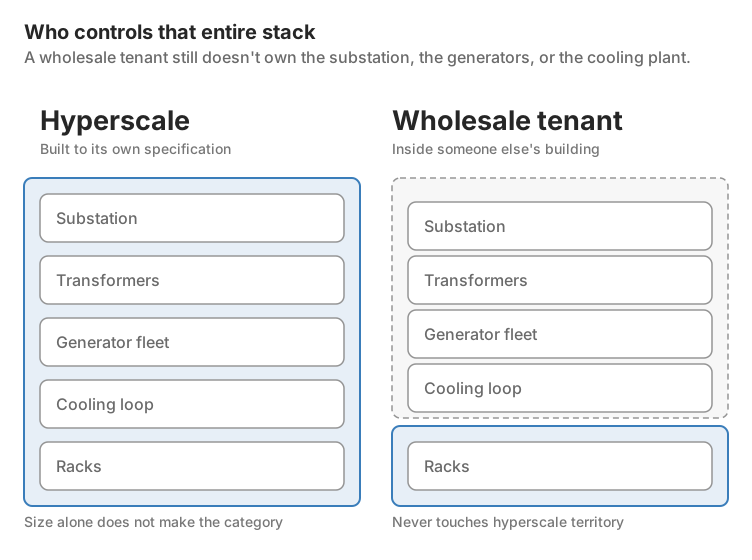
Size alone does not make the category. A wholesale tenant can lease 30MW of space inside someone else's building and never touch hyperscale territory, because it still doesn't own the substation, the generators, or the cooling plant underneath its racks. Hyperscale means the operator controls that entire stack: the on-site electrical substation, the transformers stepping voltage down from the transmission line, the generator fleet, and the cooling loop, built to its own specification rather than a landlord's. Companies like Amazon, Microsoft, and Google run this model at the largest scale, though the definition describes the ownership structure, not any particular company.
The clearest illustration of that scale is what one of these campuses actually pulls off the grid. SemiAnalysis calculates that a 300MW hyperscale campus draws roughly as much annual electricity as 200,000 US households, using an average home load of 1.214kW as the baseline (SemiAnalysis, Datacenter Anatomy Part 1, 2024). That comparison is the fastest way to understand why hyperscale siting decisions start with the utility interconnection, not the building.
Hyperscaler vs Neocloud: Two Different Ownership Models
A hyperscaler builds its own facilities and runs its own broad cloud product line; a neocloud typically doesn't build most of what it operates and sells nothing but GPU capacity. SemiAnalysis's own facility-tracking work follows more than 100 neocloud operators site by site, with end customers such as Microsoft, Meta, and OpenAI renting the clusters those operators stand up (SemiAnalysis, Datacenter Industry Model, 2025). That's the practical difference: a hyperscaler carries a full portfolio of storage, database, and platform products behind its compute; a neocloud carries one product, GPU access, and typically doesn't own the building it runs it in.
The distinction matters for anyone deciding where to run a workload. Renting from a hyperscaler buys broad platform integration and geographic reach, at hyperscaler pricing and often a longer wait for the newest hardware generation. Renting from a neocloud buys faster access to current-generation GPUs and usually lower per-hour pricing, without the surrounding platform, and often on someone else's leased site rather than a self-built one. Neither replaces hyperscale ownership itself, which remains a build decision available only to an organization with the capital and the timeline for a multi-year construction project; we cover what actually distinguishes an AI data center's hardware stack from a general-purpose facility, hyperscale or otherwise, in a companion guide.
An enterprise or sovereign entity that wants dedicated infrastructure without a self-build has a third option that sits outside this hyperscaler-versus-neocloud split entirely: dedicated capacity built to one organization's own specification, an argument laid out at length in why sovereigns and enterprises are increasingly choosing the neocloud model over either a hyperscale self-build or a shared-tenant lease.
How Hyperscale Data Centers Get Built
Hyperscale construction starts with the electrical substation, not the building, because a facility drawing 40-100MW per building needs a direct connection to high-voltage transmission lines running at 138kV, 230kV, or 345kV, and the transformers that step that voltage down are custom-made for each site's transmission characteristics, carrying lead times exceeding 12 months before construction on the building itself can finish (SemiAnalysis, Datacenter Anatomy Part 1, 2024).
Everything downstream scales from that constraint. A single hyperscale building typically runs 20 or more diesel generators rated at 2-3MW each as backup for the utility feed, roughly the horsepower of a locomotive engine per unit, holding 24 to 48 hours of fuel at full load (SemiAnalysis, Datacenter Anatomy Part 1, 2024). Design choices inside that envelope still vary enormously between operators. SemiAnalysis found that Meta's older reference building took roughly two years from start to completion, against six to seven months for a comparable Google building, a gap driven by power density: Google's buildings run more than three times denser in kilowatts per square foot, and Meta eventually scrapped an in-progress low-density building rather than finish it, once it could no longer support the rack power AI workloads required.
That timeline gap is the practical reason "hyperscale data center construction" doesn't move at a single speed across the industry. Land acquisition, utility interconnection agreements, and transformer procurement all run in parallel with the building itself, and any one of them can become the critical path. An operator can pre-order transformers during site planning to blunt the 12-month lead time, but it cannot shorten the interconnection queue a regional utility sets, which is increasingly the actual gate on how fast new hyperscale capacity comes online.
Power and Water: What a Hyperscale Site Actually Consumes
US data centers consumed 176 terawatt-hours of electricity in 2023, about 4.4% of total national demand, and the Department of Energy's Lawrence Berkeley National Laboratory projects that figure will climb to between 325 and 580 TWh by 2028, pushing data centers' share of US electricity to somewhere between 6.7% and 12% (DOE/LBNL, 2024 United States Data Center Energy Usage Report, 2024). LBNL's 2025 update raised that further, to a base case of 11.8% of US electricity by 2030, with a range of 9.5% to 15.3% depending on how fast AI deployment continues (Lawrence Berkeley National Laboratory, 2025).
Water tracks the same curve, because most cooling methods consume water either directly, evaporating it in cooling towers, or indirectly, through the water withdrawn by the power plants generating the electricity a facility draws. The nonpartisan Environmental and Energy Study Institute reports that a large data center can consume up to 5 million gallons of water per day, roughly the water use of a town of 10,000 to 50,000 people, while a mid-sized facility can use up to 110 million gallons a year for cooling alone (EESI, Data Centers and Water Consumption, 2025). The industry-standard efficiency metric, Water Usage Effectiveness, measures liters of water consumed per kilowatt-hour of energy used; EESI puts the current average at 1.9 liters per kWh, a number every hyperscale site should be working to beat rather than match.
That water figure is not just an on-site number. EESI's synthesis of federal data puts the indirect water footprint of US data centers, water consumed generating their electricity, at roughly 211 billion gallons in 2023, working out to about 1.2 gallons per kilowatt-hour of electricity consumed nationally (EESI, Data Centers and Water Consumption, 2025). That's why the cooling method a hyperscale operator picks changes its water footprint as much as its location does: direct-to-chip liquid cooling and immersion cooling both cut water use sharply compared to open-loop evaporative cooling towers, because they don't rely on evaporating water to reject heat at all.
Hyperscale vs Colocation vs Enterprise Data Centers
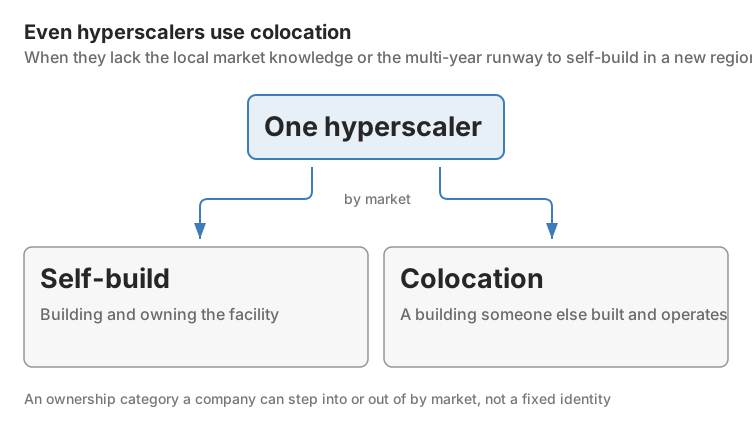
Colocation inverts the hyperscale ownership model entirely: instead of building and owning the facility, a tenant rents capacity priced in dollars per kilowatt per month inside a building someone else built and operates. SemiAnalysis sizes typical colocation tenancies at 100-500kW for retail customers and 1-5MW for wholesale customers, while hyperscale clients renting colocation space, when they choose to lease rather than self-build, typically take 5MW or more, sometimes hundreds of megawatts for a full campus lease (SemiAnalysis, Datacenter Anatomy Part 1, 2024). Even hyperscalers use colocation when they lack the local market knowledge or the multi-year runway to self-build in a new region, which means "hyperscale" describes an ownership category a company can step into or out of by market, not a fixed identity.
Enterprise-dedicated infrastructure sits on the opposite end of the scale from hyperscale but shares its ownership logic: a single organization's compute, sized to its own workload rather than shared across tenants or leased by the megawatt to whoever needs it next. An enterprise running one sustained AI workload rarely has the volume to justify hyperscale-class self-building, and usually doesn't need to. The decision that actually matters isn't the raw capacity a company can access, it's who controls the infrastructure behind it, the same tradeoff between ownership and speed that separates a self-built hyperscale campus from a leased colocation footprint or a rented neocloud cluster.
FAQ
What counts as a hyperscale data center?
A facility a single operator builds and owns for its own exclusive use, with individual buildings typically in the 40-100MW range and campuses of multiple buildings reaching several hundred megawatts (SemiAnalysis, 2024). Ownership structure, not raw square footage, is what defines the category.
How is a hyperscale data center different from a colocation facility?
A hyperscale facility is self-built and self-owned; colocation is a rented lease inside someone else's building, priced by the kilowatt per month. Hyperscalers themselves sometimes use colocation in markets where self-building doesn't make sense yet, so the two aren't mutually exclusive for a single company.
How much water does a hyperscale data center use?
A large facility can consume up to 5 million gallons of water per day for cooling, and the electricity it consumes carries its own indirect water footprint from the power plants generating that electricity (EESI, 2025). Liquid and immersion cooling cut that on-site figure sharply compared to evaporative cooling towers.
How long does it take to build a hyperscale data center?
Longer than most buyers expect, and unevenly across operators: SemiAnalysis found one hyperscaler's older building design took roughly two years start to finish, against six to seven months for a comparably sized, higher-density building from a competitor, with custom high-voltage transformers alone carrying lead times over 12 months regardless of design (SemiAnalysis, 2024).
What is the difference between a hyperscaler and a neocloud?
A hyperscaler self-builds most of its capacity and sells a full cloud product line; a neocloud typically leases the sites it operates and sells nothing but GPU access, usually at lower cost and faster availability of current-generation hardware (SemiAnalysis, 2025).
The Ownership Question Underneath the Definition
Every distinction in this guide, hyperscale against colocation, hyperscaler against neocloud, self-build against enterprise-dedicated, comes down to the same question: who controls the power contract, the construction timeline, and the hardware refresh cycle behind a given workload. Hyperscale answers that question by building and owning everything, at a cost in capital and construction time few organizations can absorb. Every other model on this page trades some piece of that control for speed. Neither choice is automatically correct, but making it without understanding the tradeoff is how organizations end up dependent on infrastructure, power capacity, and pricing they never actually decided to accept.