


Previous Post

What Is an AI Data Center?
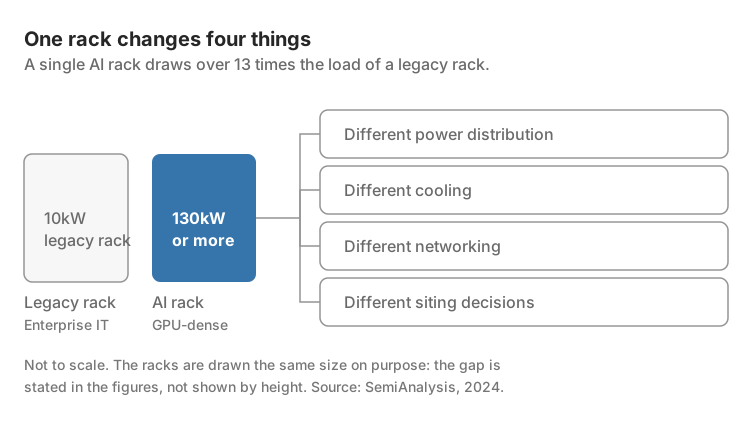
A GB200 NVL72 rack draws 130kW+, more than 13x a legacy server rack. Here is what actually separates an AI data center from a traditional one.
Zettabyte Team
September 19, 2026
What Is an AI Data Center?
An AI data center is a facility built specifically to run GPU-driven training and inference at densities a conventional data center was never engineered to hold. A single NVIDIA GB200 NVL72 rack draws 130kW or more, over 13 times the load of a legacy 10kW server rack (SemiAnalysis, Datacenter Anatomy Part 1, 2024). That single number forces different power distribution, different cooling, different networking, and different siting decisions than the data centers built for a decade of ordinary enterprise IT. By the end of this guide, you will know exactly which parts of a data center change for AI, who actually builds and operates these facilities, and what workload you would need one for in the first place.
TL;DR: An AI data center is a facility purpose-built for GPU-dense compute: high-power racks (roughly 120-130kW+ versus under 10kW for legacy IT), liquid cooling, and low-latency fabrics like InfiniBand or NVLink. SemiAnalysis tracks more than 5,000 individual facilities globally, reconciling accelerator shipments against actual grid capacity to find where operators run short of power first.
How Do AI Data Centers Work?
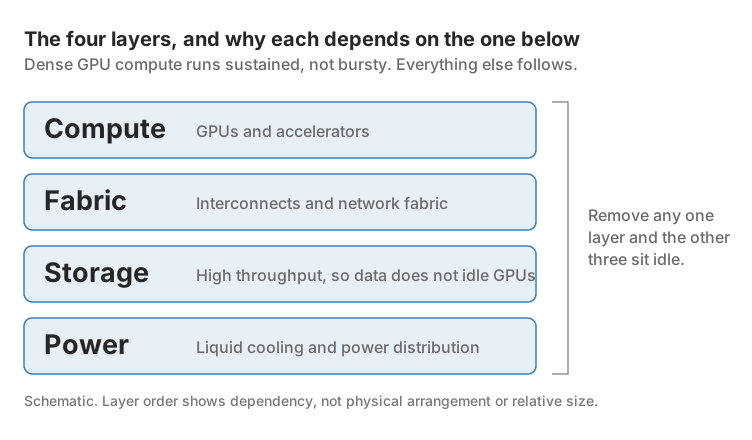
An AI data center works by pairing dense GPU compute with power, cooling, and networking systems sized for sustained, high-utilization workloads rather than the bursty, mixed traffic a traditional data center was designed around. Every other design decision in the building follows from that one difference.
The compute layer is GPUs, not CPUs. A GPU splits a problem into thousands of smaller calculations it solves in parallel, which is exactly the shape of a neural network's math. Training a large model can pull power utilization north of 80% from every accelerator in a cluster for weeks at a stretch, well above the 50-60% typical of general cloud computing workloads (SemiAnalysis, Datacenter Anatomy Part 1, 2024). That sustained draw is what pushes rack density into triple digits and why the facility's electrical design starts from the chip outward rather than from the building inward.
The networking layer has to move data between thousands of GPUs without becoming the bottleneck the GPUs are waiting on. Inside a single rack, high-bandwidth interconnects such as NVLink move data between GPUs in nanoseconds; across racks, fabrics like InfiniBand or RDMA-capable Ethernet stitch multiple racks into one training cluster. We cover this stack in depth, including the scale-up, scale-out, and scale-across distinction that governs multi-data-center training, in our AIDC networking breakdown.
The cooling layer exists because none of the above works without it. Air cannot pull enough heat off a 130kW rack fast enough to keep the chips inside their thermal envelope, so AI data centers now default to direct-to-chip liquid cooling or, at the extreme end, full immersion. Every watt not spent forcing air through a hot aisle is a watt available for compute, which is why cooling architecture is now a capacity decision as much as a facilities one.
The stack, in order: GPUs and accelerators for compute, high-bandwidth interconnects and network fabric to keep them fed, high-throughput storage so data does not idle the GPUs waiting on it, and liquid cooling plus dedicated power distribution to keep the first three running continuously. Remove any one layer and the other three sit idle. That is the entire design logic of an AI data center compressed into one sentence, and it is why retrofitting an old building rarely works as well as designing one from the electrical system up.
Hyperscale, Colocation, and Enterprise: How These Facilities Get Deployed
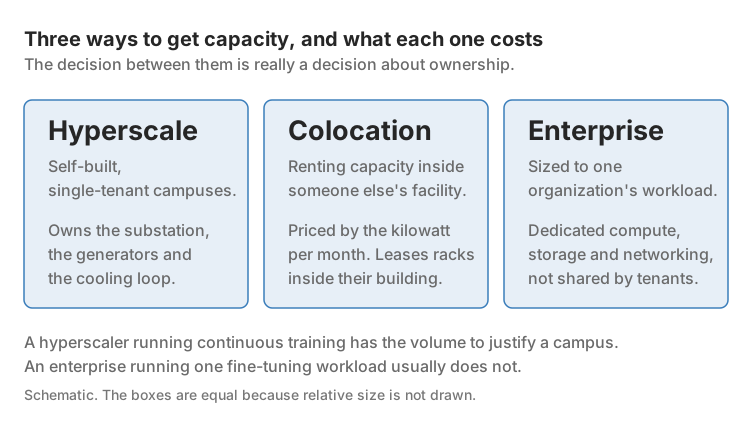
Hyperscale AI data centers are the largest category: self-built, single-tenant campuses with individual buildings routinely in the 40-100MW range, sometimes assembled into 300MW-plus campuses that draw as much power as roughly 200,000 US households (SemiAnalysis, Datacenter Anatomy Part 1, 2024). Colocation, by contrast, is renting capacity, priced by the kilowatt per month, inside a facility someone else built and operates. Enterprise deployments sit between the two: dedicated compute, storage, and networking sized to one organization's workload rather than a hyperscaler's fleet.
The decision between them is really a decision about ownership. Building hyperscale-class capacity means owning the electrical substation, the generators, and the cooling loop outright, along with the multi-year construction timeline that comes with each. Colocation trades that ownership for speed: a tenant leases racks, sometimes whole rows, inside someone else's building and its existing utility connection. Neither is universally correct. A hyperscaler running continuous training across tens of thousands of GPUs has the volume to justify a self-built campus; an enterprise running a single fine-tuning workload usually does not, and that gap is exactly what the neocloud model exists to close, renting dedicated GPU infrastructure without the capital outlay or the construction timeline of a self-build.
Enterprise AI data centers are their own category for a reason: they are sized to one company's compute, storage, and networking needs rather than shared across tenants or rented by the hour, which matters most for organizations running sustained workloads under specific security or compliance requirements they cannot hand off to a shared environment.
Who Builds and Operates AI Data Centers?
Four kinds of organizations build and operate AI data centers, and the differences between them come down to who owns the infrastructure and who is allowed to use it. Hyperscalers such as Microsoft, Google, and Amazon self-build the majority of their capacity and lease the rest, deploying it internally and to cloud customers. Neoclouds are GPU-specialist operators that build or lease capacity specifically to rent to AI labs and enterprises, without the broader cloud product line a hyperscaler carries. Colocation operators own the building and the power connection and lease rack space to any of the above. Sovereign and enterprise builders construct facilities for a single nation's or company's exclusive use, usually where data residency or security requirements rule out a shared environment entirely.
That last category is a growing share of new capacity for a specific reason: geopolitical exposure. Nations building AI capability without full ownership of the infrastructure it runs on are exposed to export controls, vendor lock-in, and third-party access to sensitive workloads, none of which are acceptable for defense, healthcare, or critical-infrastructure use cases. This is the argument behind sovereign AI data centers as a distinct build category rather than a regional variant of the same hyperscale model.
For enterprises without a sovereignty requirement, the same ownership logic still applies at a smaller scale. A company running AI workloads on infrastructure it does not control is dependent on someone else's capacity, pricing, and roadmap. Enterprise AI data centers exist to give a single organization dedicated compute, storage, and networking it operates on its own terms, without carrying the multi-year construction timeline of a hyperscale build.
What Workloads Actually Run Inside an AI Data Center?
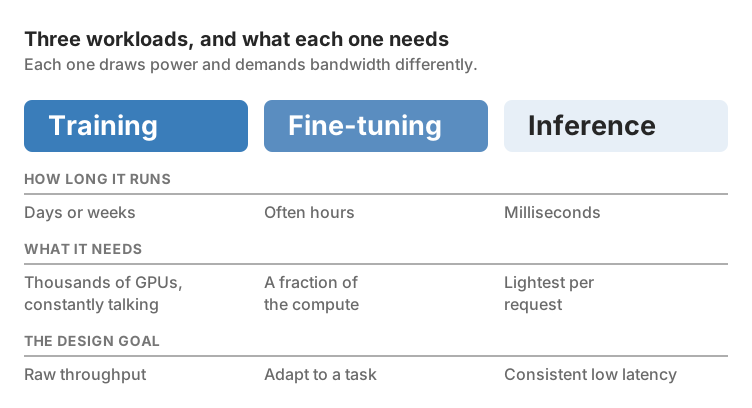
Three workload types justify AI-specific infrastructure, and each one draws power and demands network bandwidth differently. Training is the most demanding: teaching a model from scratch or continuing its pre-training requires thousands of GPUs running at sustained high utilization for days or weeks, with constant, high-volume communication between them as gradients synchronize across the cluster. Fine-tuning adapts an existing model to a specific dataset or task, which needs a fraction of the compute and often finishes in hours rather than weeks. Inference, running the trained model against new data to produce an answer, is the lightest workload per request but the most latency-sensitive: a chatbot or a fraud-detection system has to respond in milliseconds, which changes the design goal from raw throughput to consistent low latency.
That variation in workload shape is exactly why GPU access has become a service rather than something every research team builds for itself. Hugging Face and NVIDIA now let any of Hugging Face's 250,000-plus organizations request a GPU cluster on demand, sized to a specific training run, without owning or building the facility it runs in (Hugging Face, Training Cluster as a Service, 2025). The Telethon Institute of Genomics and Medicine (TIGEM), a research center studying rare genetic diseases, used exactly that model to get GPU capacity "at the right time" rather than provisioning permanent infrastructure it would only need for the length of one training run. That is the practical answer to whether every AI workload needs a dedicated data center: most do not, and matching the infrastructure to the workload, rather than defaulting to the largest possible build, is usually the more disciplined decision.
Why AI Data Center Demand Keeps Growing
Demand keeps growing because model training and inference now consume power at a scale the existing facility pipeline was not built for, and the gap between the two is the central constraint of the entire industry. SemiAnalysis tracks more than 5,000 individual data center facilities worldwide, reconciling accelerator shipments against the electrical capacity actually available to host them, specifically to identify which operators and regions run short of power first (SemiAnalysis, Datacenter Industry Model, 2025). That reconciliation exists because announcement volume and buildable power are no longer the same number.
The scale of a single new AI data center illustrates why. One NVIDIA NVL72 rack draws roughly 120-130kW, and a single gigawatt-scale AI factory requires on the order of 8,300 such cabinets before accounting for cooling and distribution losses, a density that pushes power and land requirements well past what a single traditional facility footprint was designed to hold. Multiply that by the dozens of gigawatt-class campuses under construction or planned across the US, the Gulf states, and Asia, and the constraint stops being GPU supply and becomes grid interconnection, transformer lead times, and water rights, the physical inputs a chip roadmap cannot accelerate.
This is also why the industry is diversifying away from a single deployment model. Hyperscale self-builds remain the largest category by megawatt, but colocation, enterprise-dedicated builds, and sovereign infrastructure are all growing faster than the hyperscale share alone, because no single ownership model can absorb demand growing this quickly on its own.
FAQ
How much power does a single AI server rack draw?
A rack built around NVIDIA's GB200 NVL72 draws 130kW or more, versus under 10kW for a legacy enterprise rack (SemiAnalysis, 2024). That density is the single biggest reason AI data centers need liquid cooling and dedicated power distribution that traditional facilities were not built with.
Who actually owns and operates AI data centers?
Hyperscalers, GPU-specialist neoclouds, colocation operators, and sovereign or enterprise builders each own a share of the market, and the split depends on who needs to control the infrastructure directly versus who is comfortable renting it.
Can a company rent AI data center capacity without building one?
Yes. Colocation, neocloud rentals, and on-demand GPU cluster services all let an organization access AI-grade infrastructure without owning the facility, which is the fastest way to get access to current-generation hardware without a multi-year construction timeline.
Does every AI workload need a dedicated AI data center?
No. Training a large model from scratch justifies dedicated, high-density infrastructure. Lighter workloads such as fine-tuning or low-volume inference often run efficiently on rented capacity sized to the job rather than a permanent build.
How long does it take to build a new AI data center?
Longer than most buyers expect: high-voltage transformers alone, custom-made for each site's transmission line, carry lead times exceeding 12 months (SemiAnalysis, Datacenter Anatomy Part 1, 2024), before generators, switchgear, and cooling are even accounted for. Leased or colocated capacity, by contrast, can be live in weeks because that infrastructure already exists.
The Decision Underneath the Definition
Every question in this guide eventually reduces to one: who controls the infrastructure a given AI workload runs on. Build it, and you own the timeline, the power contract, and the roadmap; lease or colocate it, and you trade that ownership for speed. Neither answer is wrong, but treating it as a foregone conclusion, defaulting to whichever model a vendor pitches first, is how organizations end up dependent on capacity, pricing, and availability they do not control. Understand the tradeoff before choosing the deployment model, not after.